
Introduction
Site selection often looks like a location availability decision, but in practice it is a strategy decision. Businesses do not grow simply by finding available sites in promising areas. They grow by choosing locations that align with market potential, customer behavior, competitive dynamics, and long-term network goals. This is why site selection and location strategy need to work together.
When location decisions are made in isolation from market strategy, customer demand, and network planning, then businesses risk entering the wrong markets, overlapping with existing locations, or investing in sites that look attractive on paper but do not support broader growth. A more strategic approach starts by identifying the areas where the business needs to expand; by analyzing where visits are coming from, how people move through those areas, how often they visit similar locations, and how much competition already exists, and then choosing sites that strengthen the overall network.
Why Site Selection Often Fails Without a Strong Location Strategy
Site selection often fails when businesses evaluate locations before defining where and how they want to grow. A site may appear promising because of visibility, traffic, or local demographics, but those signals alone do not show whether the market fits the business or supports long-term expansion goals.
This usually happens when site selection becomes reactive. Teams focus on available properties or short-term opportunities instead of using a clear location strategy to guide market prioritization, network planning, and site evaluation. As a result, a location can look strong in isolation but still underperform because it does not align with customer demand, competitive realities, or the role that site is meant to play within the broader footprint.
Without a strong location strategy, businesses also have a harder time comparing markets consistently. Decisions become more dependent on assumptions, internal preference, or timing rather than a structured view of growth potential. That makes site selection less repeatable, more risky, and harder to scale across the network.

The Limits of Evaluating Locations in Isolation
A location can look attractive on its own and still be the wrong choice in the context of the broader network. Strong visibility, nearby demand, or favorable lease terms may make a site seem compelling, but those factors do not show how it affects existing locations, whether it fills a real market gap, or how it contributes to long-term coverage and performance.
This is one of the main limits of evaluating locations in isolation. Site-level analysis can identify whether a property has potential, but it cannot fully answer whether that location strengthens the overall footprint. A new site may shift demand from nearby stores, create overlap in trade areas, or add complexity without improving market reach.
That is why site selection needs to be viewed as part of a larger system. The question is not only whether a site can perform, but whether it improves how the business serves a market, expands customer access, and supports broader network goals.
What Businesses Need to Understand Before Choosing a Site
Before comparing sites, businesses need a clear understanding of the market they want to enter and the role a new location is expected to play. Site selection is more effective when it starts with questions about customer fit, demand concentration, market opportunity, and network priorities rather than with the property itself.
That means understanding who the business is trying to reach, where those customers are coming from, how far they are willing to travel, and which areas already show signs of strong demand. It also means identifying whether a market fills a strategic gap, strengthens existing coverage, or simply overlaps with what is already in place.
Without that context, site selection can become too focused on the location in front of the team instead of the broader opportunity behind it. A better approach starts by understanding the market first, then evaluating which sites can serve it most effectively.
The Most Important Factors Behind Better Location Decisions
Better location decisions come from evaluating a site in the context of both market opportunity and network fit. Businesses need to understand not only whether a location looks promising, but whether it can attract the right customers, compete effectively, and support long-term growth goals.
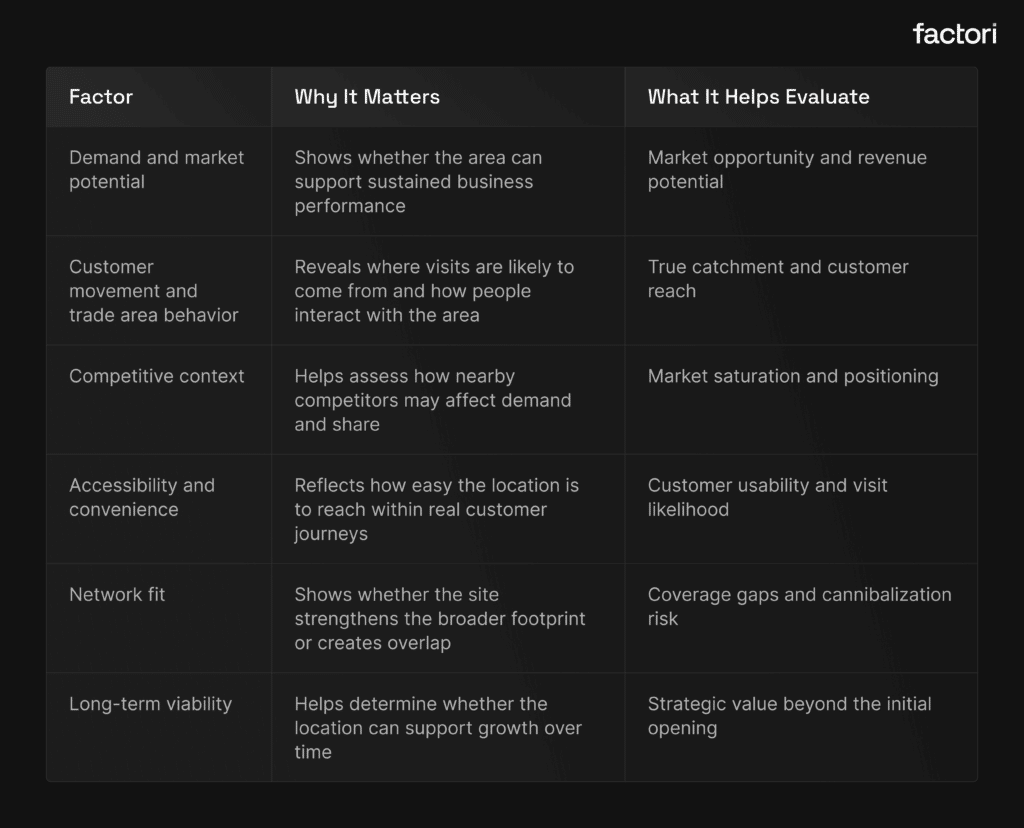
Taken together, these factors give businesses a more practical framework for comparing locations and choosing sites that support both immediate performance and broader location strategy.
How a Data-Led Approach Improves Location Decisions
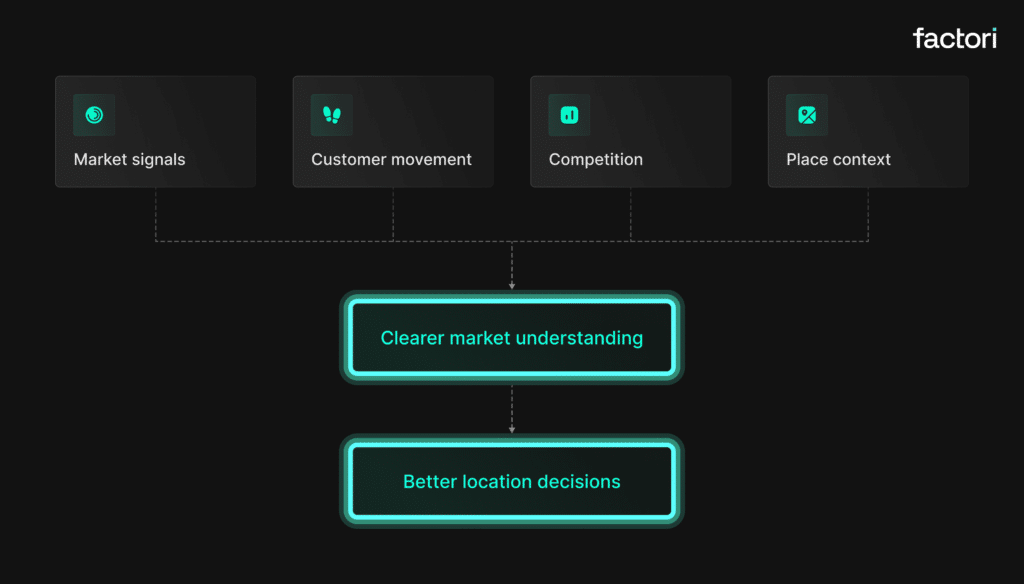
A data-led approach improves location decisions by giving businesses a clearer view of how markets behave beyond what static inputs can show. Traditional factors such as demographics, rent, and proximity remain important, but they do not fully explain where demand comes from, how people move through an area, or how competitive pressure affects performance.
This is where real-world data adds value. It helps businesses connect market planning with site evaluation by showing how customer movement, trade areas, visit patterns, and place context shape location performance. Instead of assessing a site only by what is visible on paper, teams can evaluate how it functions within the broader market and network.
What Smarter Location Planning Looks Like in Practice
Smarter location planning starts before a site is ever shortlisted. It begins with a clear view of which markets matter most, what role a new location is meant to play, and how success will be measured. That gives businesses a stronger basis for deciding whether they are filling a coverage gap, entering a high-potential market, or strengthening an existing footprint.
From there, site decisions become more structured. Instead of reviewing locations one by one based on availability or surface-level appeal, businesses can compare them using consistent criteria such as demand, customer fit, competition, accessibility, and network impact. This makes the process easier to repeat across markets and reduces the chance of decisions being driven by timing or intuition alone.
In practice, smarter planning also means looking beyond the immediate site decision. Businesses need to ask how each new location affects the wider network, whether it improves market reach, and whether it supports long-term growth. When market strategy and site evaluation are connected in this way, location planning becomes more consistent, scalable, and reliable.
How Factori Helps Businesses Make Better Location Decisions
Factori helps businesses make better location decisions with real-world data on movement, visits, and place context. These insights help teams assess demand, understand trade areas, benchmark competition, and evaluate how a site fits within a broader network.
By giving businesses a clearer view of how markets behave in practice, Factori supports more informed site selection and location strategy.
Conclusion
Site selection works best when it is guided by a broader location strategy. A site may look promising on its own, but stronger decisions come from understanding how that location fits market demand, customer behavior, competitive dynamics, and long-term network goals. When businesses take that wider view, site selection becomes less reactive and more aligned with sustainable growth.
A data-led approach strengthens that process by adding real-world context to both market planning and site evaluation. This helps businesses compare opportunities more clearly, reduce location risk, and make smarter expansion decisions.
FAQs
1. What is the difference between site selection and location strategy?
Site selection focuses on evaluating and choosing a specific location, while location strategy looks at the broader plan for where a business should grow and how each location supports that plan.
2. Why is location strategy important before choosing a site?
Location strategy helps businesses identify the right markets, growth priorities, and network goals before evaluating individual sites. This makes site selection more focused and consistent.
3. What factors matter most in site selection?
Some of the most important factors include demand, customer fit, trade area behavior, competition, accessibility, network impact, and long-term viability.
4. How does data improve site selection and location strategy?
Data improves location decisions by helping businesses understand how markets actually behave, where demand comes from, how customers move, and how competitive pressure affects site performance.
5. Why is it risky to evaluate sites in isolation?
Evaluating sites in isolation can lead businesses to overlook trade area overlap, cannibalization, market saturation, or poor network fit. A location may look attractive on its own but still fail to support broader growth goals.