Trusted by





Trusted by
QSR is won and lost on small margins and short windows: the lunch rush, the game night, the storm, the new competitor across the street.
Most retail decisions are still built on POS history and simple store clusters. That breaks when:
Factori adds the outside‑in view your systems don’t have, so you can:
Make daily and weekly plans that reflect real footfall, events, and local conditions.

Set stock and safety levels based on each store’s true demand pattern and catchment, not just chain‑wide rules.

Align staffing to when people actually shop—by daypart, day of week, season, and event.
Choose new locations and formats with a full view of audience, economics, and competition.

Aim offers, OOH, and CTV at the neighborhoods that match your best customers and categories.

You bring POS, e‑com, loyalty, and supply chain data. Factori brings the real‑world layer.
All datasets are aggregated, documented, and built to be simple to understand and join to your store list.





Where are we consistently over‑ or under‑staffed versus real traffic?
Where should we open the next wave of stores or new formats?
Why did these two similar stores diverge so much over the past year?
Which stores should get deeper inventory for this category next season?
In which trade areas are we losing share to competition, not just “the market”?
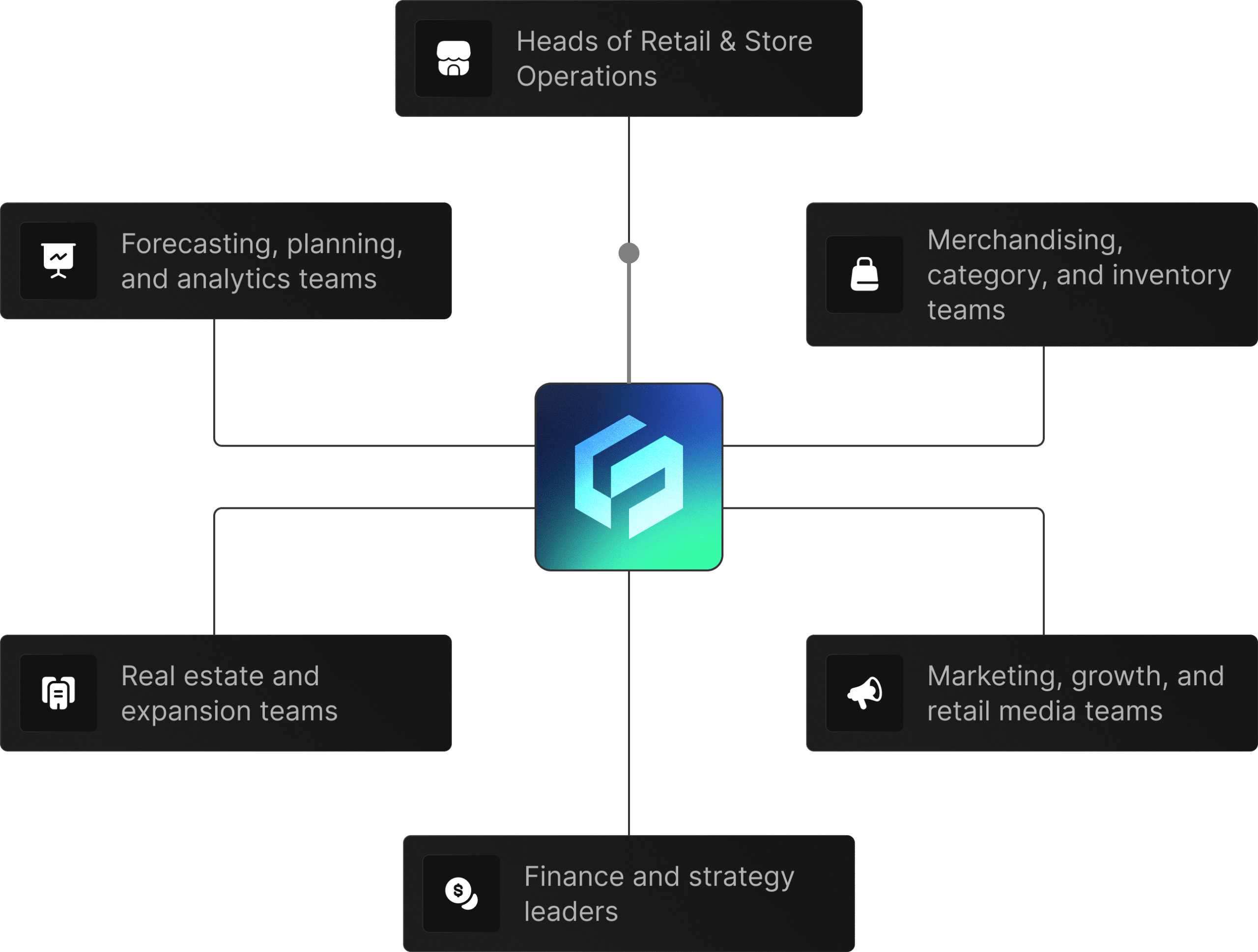
 Heads of Retail & Store Operations
who need error down and trust up.
 Forecasting, planning, and analytics teams
Looking for clean, reliable visit data to plug into models and dashboards.
 Merchandising, category, and inventory teams
Looking for clean, reliable visit data to plug into models and dashboards.
 Real estate and expansion teams
Looking for clean, reliable visit data to plug into models and dashboards.
 Marketing, growth, and retail media teams
Looking for clean, reliable visit data to plug into models and dashboards.
 Finance and strategy leaders reviewing store and market performance
Looking for clean, reliable visit data to plug into models and dashboards.
For example: forecast & inventory accuracy, underperforming regions, or upcoming store openings.

Common starting point for retail: Mobility + People + Events + Business + Retail Sales, then add Market or Economic as needed.
Compare how you plan and evaluate stores today vs. how decisions look with real‑world data, and decide where to scale first.
© 2026 Factori. All rights reserved.