Trusted by





Trusted by
Most financial decisions are still made on top of:
That makes it hard to see:
Factori adds a simple, outside‑in layer to every branch, zone, and segment, so you can:
Decide where to open, resize, reformat, or consolidate locations based on real local usage, access, and demand.

Match staffing and hours to how people actually use different locations and neighborhoods.

Add local economic and market context to credit, deposit, and claims risk views.

Aim campaigns and offers at areas where the audience and economics match each product.

Give field and relationship teams a shared view of where demand and risk are moving.

You bring account, transaction, and risk data. Factori brings the real‑world layer.
All datasets are aggregated, privacy‑safe, and designed to be easy to read and join to your branches, ATMs, territories, and customer areas.



How many people are around branches and ATMs, when they visit, and how patterns change by day and season.


Clean view of nearby stores, services, transit hubs, and key destinations around each location.




Which branches are in strengthening vs. weakening micro‑markets?
Where can we consolidate locations with minimal impact on access and service?
In which neighborhoods should we focus card, mortgage, or small‑business offerings?
How do local economics and audience profiles explain differences in branch performance?
Where is risk likely to rise next based on local employment and income trends?
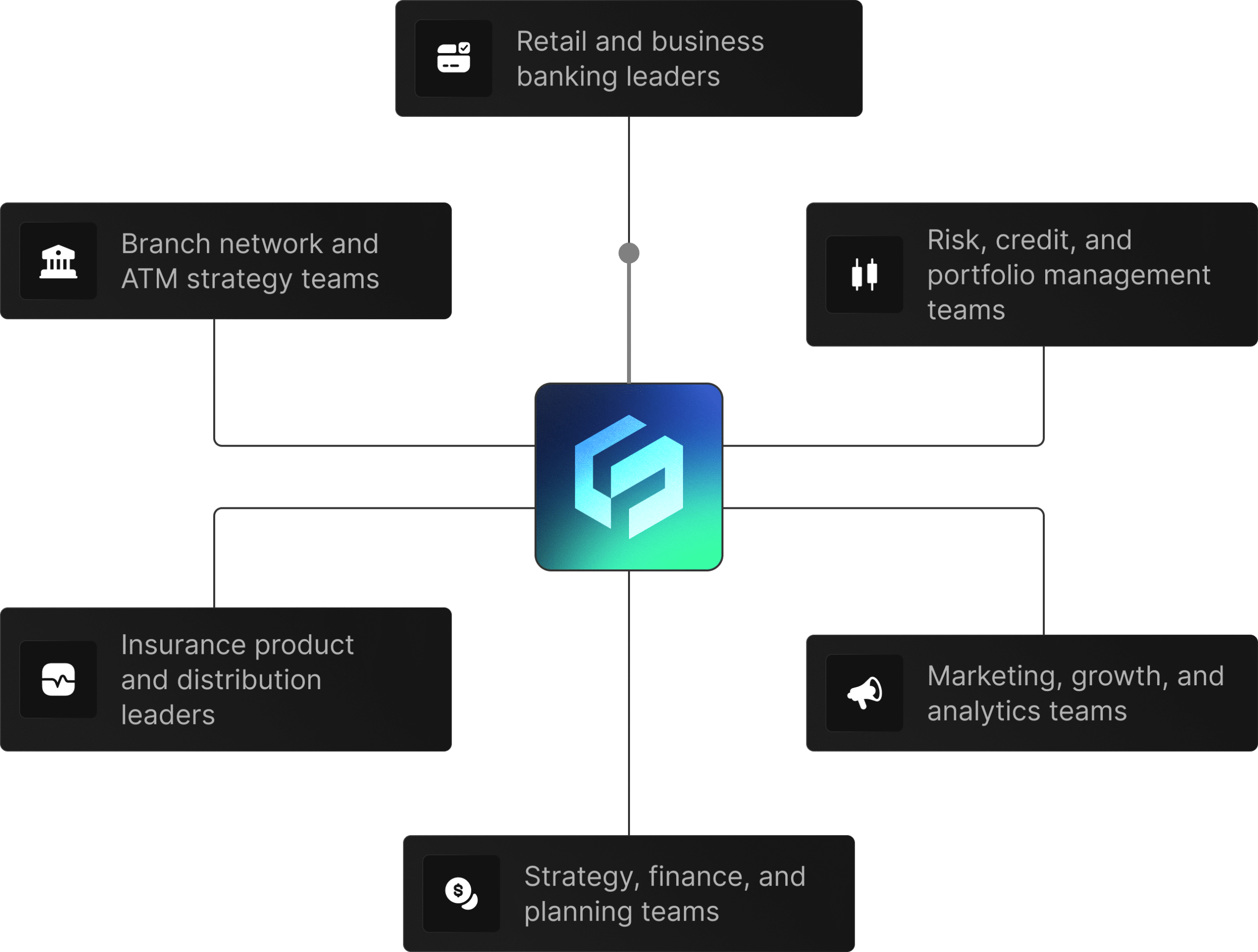
 Retail and business banking leaders
 Branch network and ATM strategy teams
 Risk, credit, and portfolio management teams
 Insurance product and distribution leaders
 Marketing, growth, and analytics teams
 Strategy, finance, and planning teams
For example: branch network review, risk and portfolio analysis, or a product growth initiative in a key region.

Common starting point for finance & insurance: People + Economic + Mobility + Business, then layer in Retail Sales, Market, and Property as needed.
Compare how you view branches, territories, or portfolios today versus a view that includes Factori data, and decide where to adjust strategy, staffing, or risk posture first.
© 2026 Factori. All rights reserved.