
Choosing the right place to open a store is one of the most important decisions a retailer can make. This is where retail location analysis becomes essential. By analyzing factors such as customer movement, surrounding businesses, and local demand, retailers can evaluate whether a location is likely to attract consistent visits and support long term store performance.
However, a location that looks promising on paper does not always perform well after a store opens. Demographics and market reports may suggest strong potential, yet the expected customer traffic never fully materializes.
This often happens because traditional site selection relies on static indicators that describe who lives in an area but not how people actually move through it. Modern retail location analysis therefore incorporates real world signals such as mobility data to better understand how customers interact with different locations.
To see how this works, it helps to first understand what retail location analysis involves and how businesses approach it today.
What Is Retail Location Analysis?
Retail location analysis is the process of evaluating potential store locations using different data signals to understand whether a place can support consistent customer demand.
Instead of relying on assumptions, businesses analyze factors such as customer movement, surrounding businesses, accessibility, and the characteristics of people in the area. The goal is to understand how attractive a location is for a specific type of retail store.
At its core, retail location analysis tries to answer a few important questions:
- Are enough people passing through this area regularly?
- Do the people visiting this location match the target customer profile?
- What other businesses or competitors are nearby?
- How far are customers willing to travel to reach the store?
By combining these insights, retailers can estimate whether a location is likely to attract steady visits and support long term performance.
In practice, this analysis relies on several data layers that help businesses understand both the environment around a location and how people interact with it.
Traditional Retail Analysis vs Real World Data Analysis
For a long time, retailers evaluated potential locations using traditional market research. These methods focused on static indicators such as demographics, income levels, and basic market surveys. While these signals provide useful context, they often fail to capture how customers actually interact with a location.
Modern retail location analysis takes a different approach. Instead of relying only on static statistics, it incorporates real world behavioral signals such as movement patterns and visit activity. This helps retailers understand how people actually move through commercial areas and which locations naturally attract demand.
The difference between these two approaches becomes clearer when we compare how each one evaluates a location.
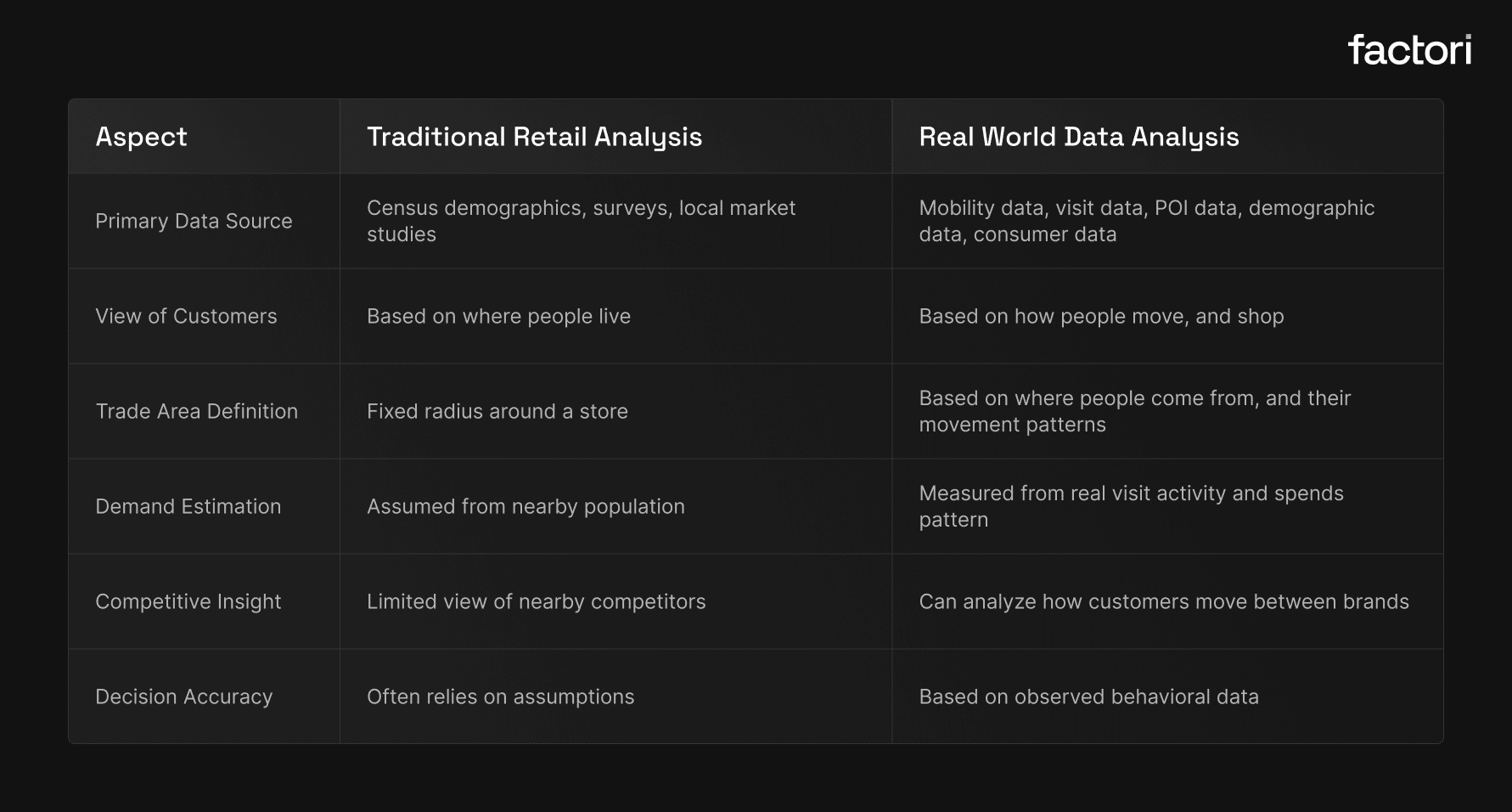
By shifting from static assumptions to behavioral insights, retailers gain a much clearer understanding of which locations truly attract customer activity. This foundation is essential before examining the limitations of traditional retail location analysis in more detail.
Why Traditional Retail Location Analysis Falls Short
Traditional retail location analysis has helped businesses evaluate markets for decades. Demographic reports, income statistics, and population density often form the foundation of site selection decisions. These indicators provide useful context about the people living in an area and the potential purchasing power of a neighborhood.
However, these signals only provide a partial picture of how a location actually performs in the real world. They describe the characteristics of an area, but they do not capture how people behave within it.
To understand the limitation, consider a common situation. Two retail locations may have very similar demographics, population size, and income levels. Traditional analysis would suggest that both locations have similar demand potential. Yet once stores open, one location may attract steady customer visits while the other struggles to generate consistent traffic.
The difference often comes down to factors that traditional analysis cannot easily measure. For example:
- How people move through nearby streets and commercial areas
- Which locations fit naturally into daily travel routes
- How nearby businesses influence overall foot traffic
- Where customers prefer to shop rather than simply where they live
Because traditional analysis does not capture these behavioral signals, retailers can miss important patterns that shape real customer demand. This is why modern retail location analysis increasingly combines multiple data layers to understand how retail activity actually unfolds around a location.
Also read: Retail Store Cannibalization: Why New Store Openings Drain Sales and How to Stop It
Key Data Layers Used in Retail Location Analysis
To evaluate a retail location accurately, businesses need to look beyond population statistics or basic market reports. Retail location analysis relies on multiple data layers that reveal how people interact with an area and what businesses operate nearby.
Some of the most important data layers used in retail location analysis include foot traffic patterns, consumer demographics, nearby businesses, and trade area dynamics.
The following sections explore these data layers in more detail and explain how each one contributes to stronger site selection decisions.
1. Foot Traffic and Mobility Data
Foot traffic and mobility data show how many people visit an area and how they move through it throughout the day. These datasets help retailers measure activity around streets, shopping districts, and commercial zones. By analyzing these patterns, businesses can identify high-traffic locations, understand peak visit times, and evaluate whether an area attracts consistent customer movement.
2. Demographics and Consumer Profiles
Demographic and people data help retailers understand the characteristics of people around a location, including age groups, household income, family composition, and spending capacity. These insights help businesses evaluate whether the local audience aligns with their target customers. When combined with movement data, demographic insights provide a clearer picture of both the size of the audience and the type of customers likely to visit a store.
3. Competitor and POI Analysis
Points of Interest(POI)data helps retailers understand the commercial environment around a location, including nearby stores, restaurants, offices, and entertainment venues. Analyzing competitor presence helps assess market saturation, while complementary businesses can increase overall foot traffic. Retailers use these insights to identify strong retail clusters, emerging commercial zones, and areas where demand may still be underserved.
4. Trade Area and Catchment Analysis
Trade area analysis identifies where a store’s customers are likely to come from. Instead of relying on a simple radius around a location, retailers analyze travel patterns, accessibility, and nearby retail options to understand the true catchment area. These insights help estimate how far customers are willing to travel, which neighborhoods contribute the most visits, and how demand overlaps with nearby retail locations.
Combining these data layers helps retailers evaluate locations more accurately. Instead of relying on static indicators, businesses gain a clearer view of demand and how an area functions as a retail environment.
A Step-by-Step Framework for Retail Location Analysis
Retail location analysis becomes much more reliable when businesses evaluate potential sites using multiple data signals rather than relying on a single indicator. A structured framework helps retailers systematically assess demand, customer behavior, and competitive conditions before committing to a location.
A typical data-driven location analysis process includes the following steps.
1. Define the Target Customer
The first step is identifying the type of customer the store is meant to serve. Retailers define their target audience based on factors such as demographics, spending patterns, and lifestyle preferences. This helps narrow down locations where the right customer segments are likely to be present.
2. Analyze Foot Traffic and Mobility Patterns
Next, businesses evaluate how active a location is. Mobility and foot traffic data reveal how many people pass through an area, when peak activity occurs, and which streets or commercial zones attract regular visits. Locations with steady movement often provide stronger retail potential.
3. Map Trade Areas and Catchment Zones
Retailers then analyze where visitors are likely to come from. Trade area analysis helps determine the geographic reach of a store and which neighborhoods contribute the most potential customers. This step also helps identify overlaps with nearby retail areas.
4. Evaluate Competitor Presence
Understanding the competitive environment is essential. Retailers analyze nearby competitors as well as complementary businesses that may drive additional foot traffic. This helps determine whether the area is oversaturated or part of a strong retail cluster.
5. Assess Accessibility and Surrounding Environment
Accessibility can strongly influence store visits. Retailers evaluate factors such as road connectivity, public transport access, parking availability, and overall visibility of the location. These factors often determine how convenient a location is for potential customers.
6. Compare and Score Potential Locations
Finally, businesses compare shortlisted locations using multiple signals such as demand potential, customer activity, accessibility, and competitive intensity. Scoring locations based on these factors helps decision makers prioritize the sites with the strongest overall potential.
Following a structured, data-driven framework helps retailers reduce uncertainty and make more confident site selection decisions.
Common Mistakes in Retail Location Analysis
Even with access to better data, retailers can still make location decisions that overlook important signals. Retail location analysis works best when multiple factors are considered together. Focusing too heavily on one indicator often leads to incomplete conclusions.
Some common mistakes include:
1. Relying only on demographics
Population size and income levels provide useful context, but they do not reveal how people actually shop. A neighborhood with strong demographics may still experience low retail activity if customers prefer nearby shopping districts.
2. Assuming customers come only from nearby areas
Many location decisions are based on fixed radius trade areas. In reality, customers often travel across neighborhoods for work, errands, or specific brands. Ignoring these movement patterns can lead to incorrect demand estimates.
3. Misjudging trade areas
Retailers sometimes assume a store’s customers will come from a simple geographic radius. In reality, trade areas are shaped by travel patterns, accessibility, and nearby retail options. Misjudging the true catchment area can lead to inaccurate demand estimates.
4. Overestimating demand potential
A location may appear promising based on a single indicator such as population size or foot traffic. However, demand can be overstated if other factors such as competition, accessibility, or customer preferences are not considered together.
Avoiding these mistakes requires a broader view of the retail environment and the use of multiple data layers to understand how a location truly performs.
How Factori Enables Data-Driven Retail Location Analysis
Retail location analysis becomes much more effective when businesses can combine multiple data signals into a single view of a location. Factori helps retailers do this by providing datasets that reveal both the environment around a store and how people interact with it.
For example, mobility data helps retailers understand how people move across neighborhoods and commercial areas. Businesses can analyze where visitors are coming from, which locations attract consistent activity, and how movement patterns change throughout the day or week.
Factori also provides points of interest data, which helps retailers understand the business landscape around a potential store location. This includes nearby competitors, complementary businesses, offices, restaurants, and other destinations that influence foot traffic.
In addition, people datasets help retailers evaluate whether the audience visiting an area matches their target customer profile. This makes it easier to identify locations where both demand and customer fit are strong.
By combining these data layers, retailers can analyze demand patterns, evaluate competition, and identify locations that naturally attract customer activity. This allows businesses to move from assumption-based decisions to a more structured, data-driven approach to site selection.
Conclusion
Selecting the right retail location requires more than reviewing population statistics or basic market reports. While traditional indicators provide useful context, they often miss how customers actually interact with a place. Retail location analysis becomes far more effective when businesses evaluate real-world signals such as customer movement, surrounding businesses, and audience characteristics.
By combining these data layers, retailers can gain a clearer view of where demand truly exists and how a location fits into everyday shopping behavior. This makes it easier to compare potential sites, reduce uncertainty, and prioritize locations that are more likely to attract consistent visits.
For businesses planning expansion or evaluating new markets, using real-world data can significantly improve the accuracy of site selection decisions. If you want to explore how data can support smarter retail location decisions, you can talk to an expert or get started for free to see how Factori helps analyze locations using real-world insights.
FAQs
1. What is retail location analysis?
Retail location analysis is the process of evaluating potential store locations using data such as foot traffic, customer demographics, nearby businesses, and movement patterns. It helps retailers identify locations that can support consistent customer demand.
2. How do retailers choose the best location for a store?
Retailers choose store locations by analyzing multiple datasets that reveal how people interact with an area. This often includes mobility data to understand movement patterns, visit data to measure location activity, POI data to evaluate nearby businesses, and people or consumer data to assess whether the local audience matches the brand’s target customers. Combining these datasets helps retailers evaluate demand and make more informed site selection decisions.
3. What factors determine a successful retail location?
A successful retail location typically depends on measurable factors such as relevant high and consistent foot traffic, strong alignment with the target customer segment, a healthy mix of complementary businesses nearby, easy accessibility through roads or transit, and active retail spending in the area.
4. What data is used in retail location analysis?
Retail location analysis uses multiple datasets to understand demand and market conditions. Common data sources include mobility or foot traffic data, retail spend insights, demographic and consumer data, POI or business data, property information, and market growth trends. These datasets help retailers evaluate customer activity, surrounding businesses, and the overall potential of a location.
5. How does mobility data help in retail location analysis?
Mobility data reveals how people move between neighborhoods and commercial areas. Retailers can use these insights to identify high-activity locations, understand visitor origins, and evaluate whether a location attracts consistent customer movement.