
Choosing the right retail location has a direct impact on store performance, brand visibility, and long-term returns. In the high street vs mall decision, retailers need to weigh customer fit, cost structure, operational flexibility, and profitability before committing to a site.
High street locations can offer stronger local presence and day-to-day visibility, while malls can provide concentrated shopper traffic and a more managed retail environment. The better choice depends on how well the location aligns with the brand’s audience, store format, and growth goals.
High Street vs Mall: Distinct Shopping Experiences
The difference between a high street and a mall starts with how customers use the space. While both can attract retail demand, they shape shopper behavior in different ways.
A high street is part of a wider urban or neighborhood setting, where visits are often linked to commuting, errands, dining, or everyday routines. A mall offers a more controlled retail environment, where shoppers often arrive with clearer purchase intent and benefit from shared infrastructure, convenience, and proximity to other brands.
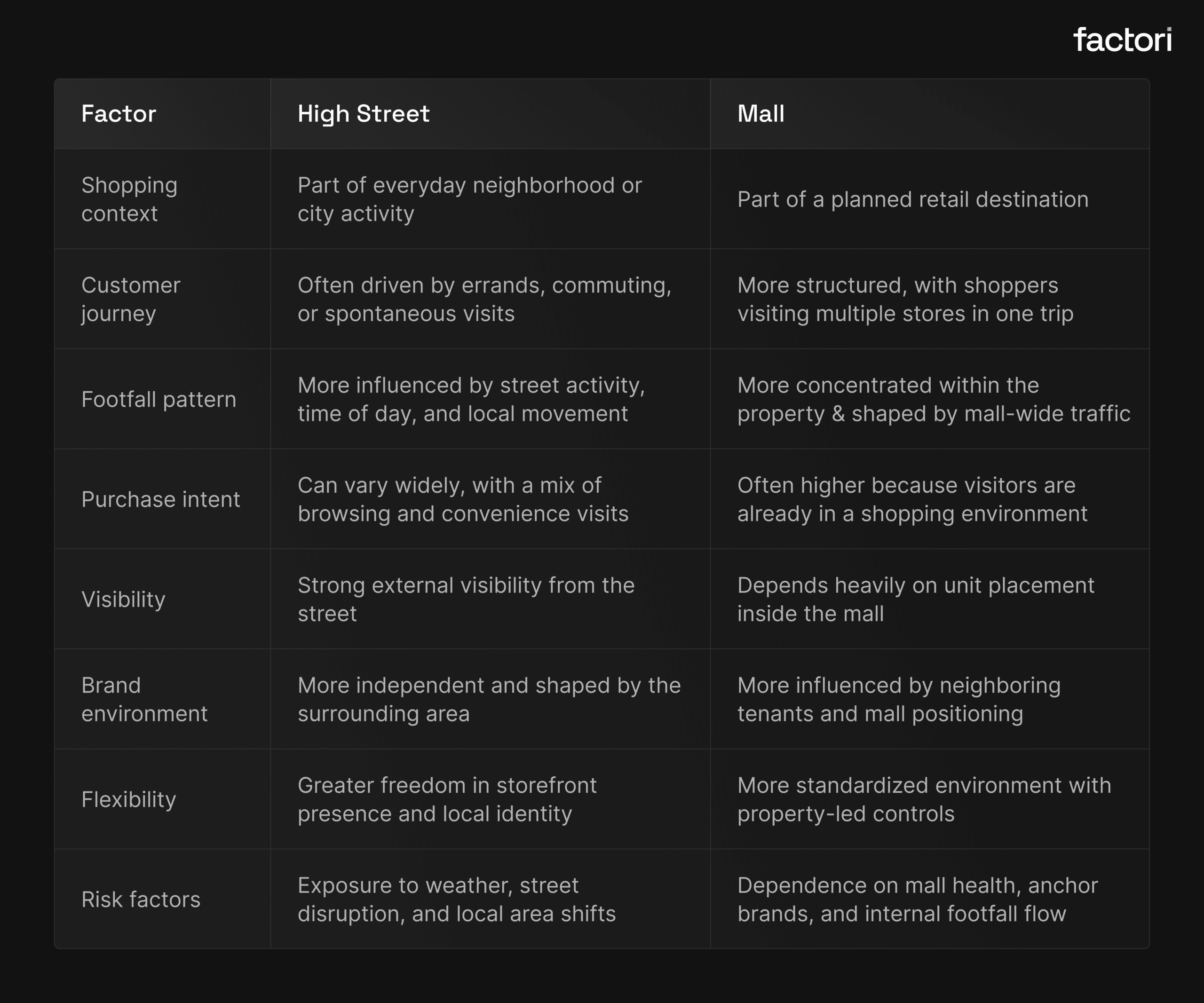
These differences affect how customers discover the store, how often they return, and how much control the retailer has over performance. In the high street vs mall decision, the better choice is usually the one that aligns most closely with the brand, store format, and local demand.
Key Factors for Choosing the Optimal Retail Site
Choosing between a high street and a mall involves more than comparing rent or visitor numbers. Retailers need to assess customer fit, operating conditions, and whether the site can deliver sustainable returns.
Lease and Occupancy Costs
In the high street vs mall decision, cost goes beyond base rent. High street stores may offer simpler leases, but they can still involve taxes, maintenance, and fit-out costs. Mall stores often come with more structured terms and added charges such as service fees and marketing contributions.
Footfall and Customer Fit
Footfall volume matters, but footfall quality matters more. High street locations often attract a broader mix of commuters, residents, and passersby. Mall locations usually attract shoppers with stronger purchase intent and longer dwell time.
Visibility and Marketing Impact
Visibility affects how easily a store can attract visits and build brand presence. High street stores benefit from direct street exposure, while mall stores depend more on internal positioning and shopper flow. In both cases, the real question is whether visibility converts into sales.
Size and Layout
A strong location can still underperform if the space does not fit the store format. High street units may vary widely in size and layout, while mall units are often more standardized but less flexible. Retailers need to assess whether the space supports operations effectively.
Compliance and Licensing
Compliance can affect both cost and feasibility. High street stores may face local rules around signage, access, parking, or building changes. Mall stores may face property-level controls on design, fit-out, promotions, and operating hours.
Profitability Potential
The best site is not always the busiest or the cheapest. It is the one most likely to generate healthy returns after cost, customer quality, conversion potential, and operating fit are considered together. In the high street vs mall comparison, profitability should be judged as a full location equation.

Navigating Retail Risk: A Data-Driven Approach
Retail risk cannot be assessed through rent or footfall alone. In the high street vs mall comparison, retailers need to understand how a location performs within its wider market, not just how busy or expensive it appears.
A data-driven approach helps bring that context into view. Mobility data shows how people move through a high street, shopping district, or mall catchment. Visit data helps assess how consistently a location attracts demand over time.
POI data adds context on nearby competitors, anchors, and complementary businesses, making it easier to understand the surrounding retail environment. People data helps retailers assess whether the audience around a site aligns with the brand.
Taken together, these signals give a more complete view of site potential and site risk. This supports stronger decisions across retail site selection, market intelligence, and store network planning.
How Factori Helps You Assess Retail Risk at Mall and High Street
Factori helps retailers compare high street and mall locations using multiple real-world data layers, so site decisions are based on actual market conditions rather than surface-level assumptions.
Mobility data shows how people move through high streets, shopping districts, and mall catchments. Visit data helps assess how consistently locations attract demand and how nearby retail destinations influence performance. POI data gives context on competitors, anchors, and complementary businesses around a site. People data adds audience insight, helping retailers understand whether the customer profile aligns with the brand.
Together, these datasets support stronger decisions across site selection, trade area analysis, market intelligence, and store network planning. In the high street vs mall comparison, this helps retailers assess risk and opportunity with more confidence.
Talk to an Expert
Conclusion
The high street vs mall decision is about choosing the location that best fits the brand’s customers, operating model, and commercial goals. What matters most is how each site performs across cost, customer fit, retail context, and long-term profitability. To assess retail risk with a clearer view of movement, visits, place context, and audience fit, get started with Factori.
FAQs
What is the difference between a high street and a mall in retail?
A high street is part of an open urban or neighborhood environment where stores are accessed directly from the street. A mall is a managed retail property where stores operate within a shared commercial space. In the high street vs mall comparison, the main difference lies in customer movement, store visibility, operating conditions, and surrounding retail context.
Which is better for retail, a high street or a mall?
Neither is better by default. The right choice depends on the brand, target customer, product category, store format, and cost structure. Some retailers benefit from the visibility and flexibility of a high street, while others perform better in malls where shopper intent and co-tenancy can be stronger.
Is footfall higher in malls than on high streets?
Not always. Malls may offer more concentrated retail footfall, while high streets can benefit from broader daily movement driven by commuting, errands, dining, and local activity. What matters more than volume is footfall quality, including whether the visitors are relevant to the brand and likely to convert.
Are mall stores more expensive than high street stores?
Mall stores can involve higher total occupancy costs because rent may be combined with common area maintenance fees, service charges, and marketing contributions. High street stores may have simpler lease structures, but costs can still vary depending on frontage, taxes, fit-out, and local demand. Retailers should compare total cost, not just base rent.
What are the risks of opening a store on a high street?
High street locations can be affected by changing neighborhood demand, street-level disruption, weather, parking limitations, and inconsistent movement patterns. Performance may also depend heavily on the surrounding mix of businesses and how visible the store is within the area.
What are the risks of opening a store in a mall?
Mall stores may depend more on internal shopper flow, tenant mix, anchor performance, and property-level rules. Higher fixed costs and limited flexibility around store operations or promotions can also affect performance. A strong mall address does not automatically guarantee strong store profitability.
How can retailers compare high street and mall locations more effectively?
Retailers can compare locations more effectively by looking beyond rent and raw footfall. A better evaluation includes movement patterns, visit behavior, nearby competitors, place context, customer profile, and long-term profitability potential. This gives a more realistic view of site performance and retail risk.